WORCESTER |
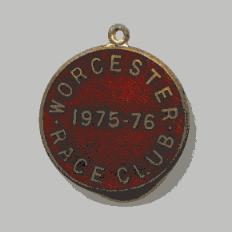
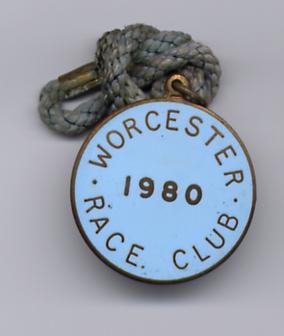
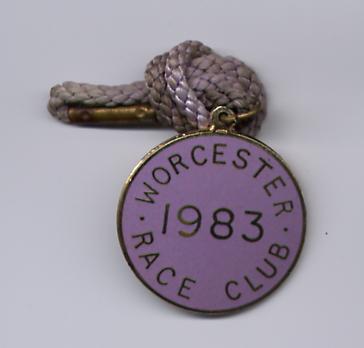
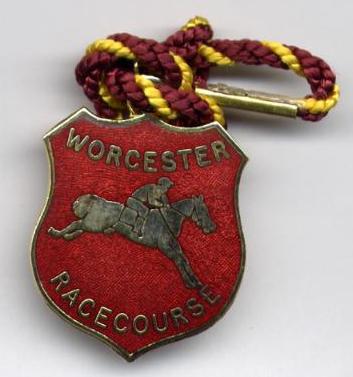
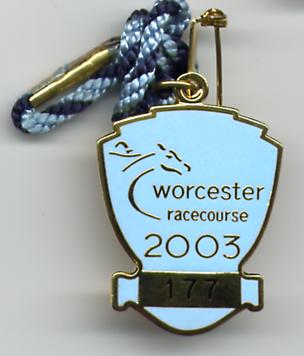
Badges through the decades |
Brief History |
||
| 1718 Earliest evidence of a meeting at Pitchcroft,Worcester on 20th June in which horses ran the best of 3 two mile heats and the winner was to be sold for £7. 1739Records show that racing continued and that Cato, carrying 11st on 22nd August, won a 40 guineas race. 1754 The programme was extened to include a 3 day programme. 1755 Building on its earier successes, the programme was extended to a fourth day, when racing on the final day started at the Green Dragon. 1823 By now the racecard included prestigious races like the Worcester Gold Cup, won twice by Euphrates, and the Worcester Stakes. 1880 The new track is laid out and used for the first time. Thoughts about The Pitchcroft, by Eric Graham “Everything you write ends up as bloody autobiography!” I was being
addressed by an editor. We were trying to put together a ‘Come and Enjoy Sport in Although the remark was true, as was much of what was said in the off-Fleet Street
pub we frequented at lunch times, I was somewhat put out. The previous Saturday I had made
my first visit to The Pitchcroft, or That day was my kind of race-day. Pouring rain, visibility ranging from misty to
near impenetrable, nine races too. I fell in love with the place. ~ ~ ~ ~ In the best racing book that has been, or ever will be written, J C Whyte refers to
racing on Pitchcroft meadow. They then had two meetings; an August two day affair and a
single day in November, the latter being dismissed as a hunters stakes event for gentleman
riders. Worcestershire at this time, 1840, had meetings at Bromyard, Dudley, Stowebridge,
Upton upon Main races were the Worcestershire Stakes, a two miler. A six furlong sprint for two
and three year olds [the Malvern Stakes] and The Gold Cup over a stamina testing three
miles. All was presided over by William Tolley, clerk of the Course. Unlike many courses
at this time By the time Whyte was putting together his magnum opus there had been racing
on The Pitchcroft for over 100 years. In 1718 a race for a saddle was advertised for
horses carrying 10 stone in three 2 mile heats. In addition pedestrianism featured. A race
for men with a pair of silver buckles as reward and a contest for ladies with a 14
shilling hat as first prize. That must have been some day out! Up to the first world war there were two ferries crossing the For over 120 years Cutting out the Flat was supposed to save money, a move that obviously did not work
as by 1984 an application was made to the Jockey Club for flat fixtures again. The J C was
having none of this. At the time the Club’s master plan of cutting the calendar down
to twelve flat and six jumping courses was in full flight. And guess one of those to get
the chop if ‘The Plan’ went through? Still, not getting the fixtures did not
hurt the course over much as by 1989 it was making a profit of £190,000 a year. Following the loss of flat racing it was decided to ‘upgrade the facilities’.
This term means ‘destroy any vestige of good architecture, throw tarmac over every
blade of grass you can and cut down all the trees‘. When I first arrived on the
course I was much taken with the brick stand. Highly convenient. Everything to hand and
excellent viewing. The parade ring was close by. In fact if you liked horses, liked to bet
and liked a drink As the course is flat, by the river An indication of ‘climate change’ may be given by the mid-Victorian
weather; 1861 to be precise. It was a hard winter and the But I bet they did not have as much fun as I did on that first visit to The
Pitchcroft. As I made my way back to the station with the lights shining brightly I
resolved to come again and I did.
Forty odd years on I cannot remember any of the horses I saw in my first few visits apart from the little mare Solomon’s Bride. She was given a magnificent reception after winning a novices’ chase. When I walked through the ring on the way to the paddock three and a half was readily available but from the noise round the unsaddling enclosure I think that and a good deal shorter was taken.
|
|
1966
The last flat meeting took place on 20th August. 1975 The new grandstand is completed and opened on 26th March. |
||
|
||||
|
||||
 |
||||
 |